Home > About Nubilosa > Nozzle

Nozzle
Nubilosa One Fluid Pressure Nozzle, Two Fluid Nozzle, Three Fluid Nozzle, Multiple Channel Nozzle, Special Construction Nozzle
1. One Fluid Pressure Nozzle, Hollow Cone Nozzle
The liquid atomizes in this nozzle type from a thin hollow cone escaping from the nozzle bore at high velocities. Therefore this nozzle needs a relativly high liquid pressure from 5 to over 100 bar. The droplets form very uniform in diameter with a narrow distribution.
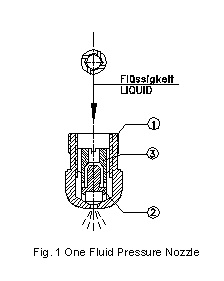 |
The nozzle (fig. 1) consists from the body (1), the swirl insert (2) and an fixation screw (3). There are no moving parts. Changing the area relation between swirl insert and bore the cone angle will be changed. This angle may be easy adopted to any application. At the same time the droplet diameter will be changed. Greater cone angles at the same liquid pressure produce finer droplet diameters.
The droplet diameter depends further strongly on the liquid pressure. Increasing pressure leads to smaller droplets and a more narrow droplet distribution.
Selection of the appropiate material of the nozzle prevents the bore to become bigger by abrasion, if the liquid contains abrasive particles.
The one fluid pressure nozzle shall be used mainly for atomization of solutions, emulsion, dispersions or suspension with small primary particle size. The nozzle does not block reliable if the liquid shows homogenity. The droplet spectrum is marked by a narrow distribution. The energyconsumption is noticable smaller then that of two fluid nozzles or disc atomizers.
Technical Data
Throughput: 1 to 500 kg/hr per nozzle
Pressure: 5..200 bar
Spraying cone angle: 30..90 degree
Material: stainless steel AISI316 Ti, hard metal
2. Two Fluid Nozzles Type NUBILOSA
 |
The nozzle (fig.2) consists from the body (1) with the tangential atomizing gas inlet, the inner spindle (2) with the bore for the liquid and a fixation screw (3). The nozzle may be flanged to a vessel with the bajonet flange (4). There are no moving parts.
The droplet size depends on the following parameters:
- the liquid properties viscosity, surface tension and density,
- the atomizing gas pressure,
- the mass ratio MR between the atomizing gas flow and the liquid mass flow,
- the nozzle size.
Increasing viscosity, surface tension or density increases the droplet size, increasing atomizing pressure and an increasing mass ratio MR produce smaller droplets. Because the mass flow of the atomizing gas through the nozzle depends on the atomizing pressure, changing this pressure is a very simple method to influence the droplet size.
The nozzle has a built on bajonet flange for easy inspection of nozzles flanged to vessels.
Technical Data:
Throughput: 1to 500 kg/hr per nozzle
Liquid pressure: +-80 mbar (depending on throughput and liquid viscosity)
Atomizing pressure: 0.5..5 bar
Spray cone angle: 30 degree
Material:
body stainless steel 1.4581 (AISI316)
spindle 1.4571 (AISI316 Ti)
Home About Nubilosa Delivery Program Product Experience Nozzle Pilot Plant Contact Top of Page Deutsch |